
Metal profiling is the process of cutting sheet, plate or other flat materials into a specified shape using a computer-controlled or manually operated cutting process.
Modern CNC metal profiling allows manufacturers to produce everything from simple brackets and plates to complex components with hundreds of holes, slots and intricate contours.
However, there is no single cutting process that is best for every application.
But why profile parts at all? Could you not just machine them?
Machining is wasteful and time consuming. If you were to start with a large rectangular piece of steel, you would have to machine away the rest of the material and turn it into chips. That means an expensive C.N.C machine and all of it’s consumables running for an extra hour or so. If you start with a profiled piece of material you can squeeze more parts into a blank piece of steel.
Although we offer machining services either when prototyping or during production, we will be the first to admit that it isn’t always the best option.
Sometimes, as is the case with the component in the video below, you don’t even need to machine finish every surface. If it doesn’t need to be pretty you only need to finish mating surfaces.
The four most commonly used industrial profiling processes are:
- Waterjet cutting
- Laser cutting
- Plasma cutting
- Flame or oxy-fuel cutting
Each process has different strengths. The best choice depends on the material, thickness, required accuracy, production quantity, edge quality, cost and whether heat can be introduced into the component.
This guide explains how each process works and compares the advantages and disadvantages of waterjet, laser, plasma and flame cutting.
Important: Maximum thicknesses and tolerances vary considerably between machines. The figures below are useful practical guides rather than universal limits.
What do I need to get started?
Ideally you need a C.A.D. file, something that we can provide at competitive rates.
Quick comparison of metal profiling processes
| Process | Typical materials | Typical thickness range | Accuracy | Heat affected zone | Relative cost | Speed |
|---|---|---|---|---|---|---|
| Waterjet | Almost all metals, composites, stone, glass, plastics | Up to 300 mm+ | Excellent | None | £££ | Medium |
| Laser | Mild steel, stainless, aluminium, copper, brass and some non-metals | 0.5–30 mm+ | Excellent | Small | ££–£££ | Very fast on thin sheet |
| Plasma | Mild steel, stainless, aluminium and other conductive metals | 0.5–50 mm+ | Good–excellent | Small–medium | £–££ | Fast |
| Flame | Mild and low-alloy steel | Approx. 3–250 mm+ | Moderate | Large | £ | Slow–medium |
ISO 9013 provides a useful framework for classifying the geometric quality and tolerances of thermal cuts. Its scope includes flame cutting from 3–300 mm, plasma cutting from 0.5–150 mm and laser cutting from 0.5–32 mm. (ISO)
1. Waterjet Cutting
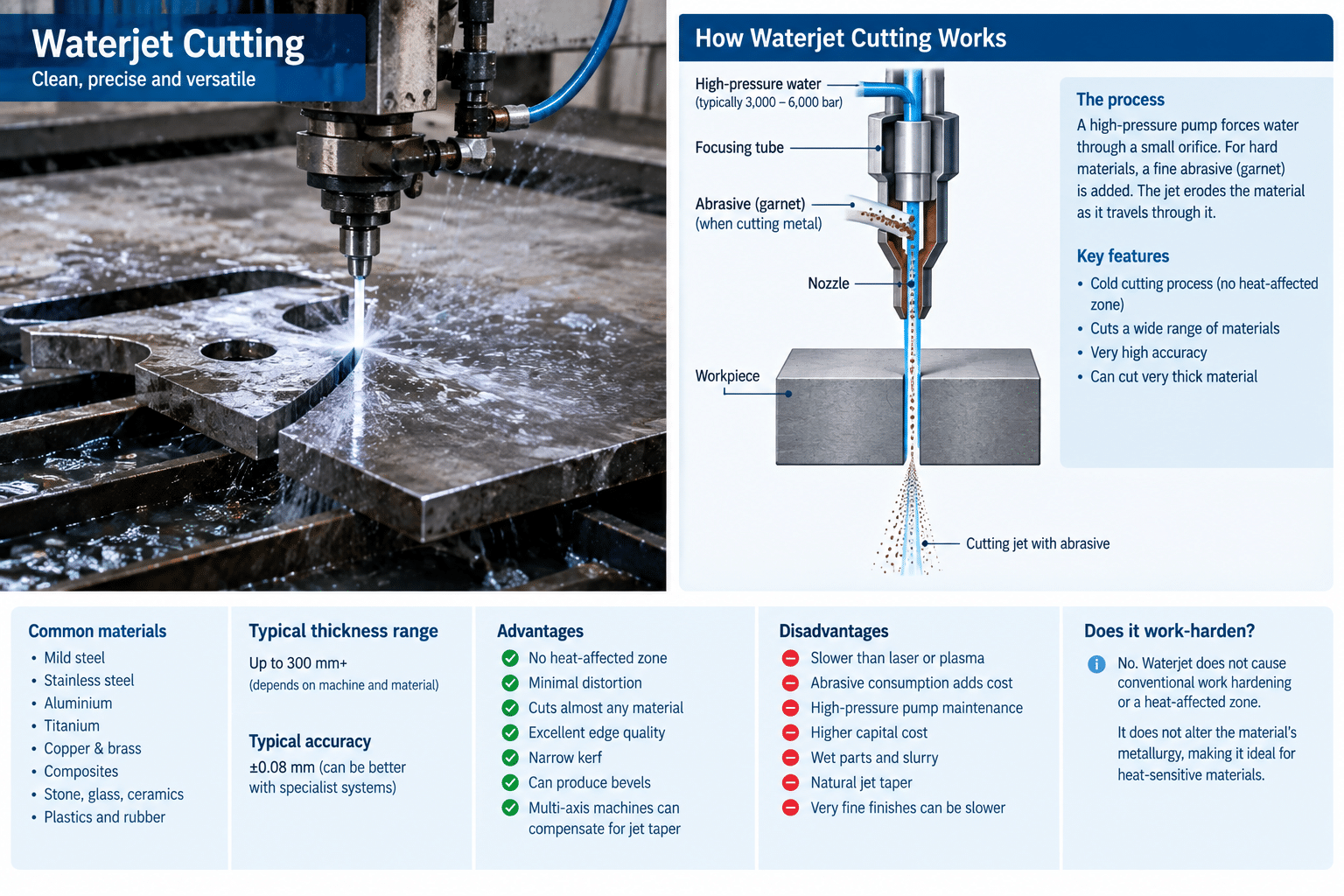
Waterjet cutting is one of the most versatile methods of material profiling because it does not rely on heat.
Instead, the machine uses an extremely high-pressure stream of water. When cutting hard materials, a fine abrasive such as garnet is added to the water jet.
The abrasive particles erode the material as the jet passes through it.
How does waterjet cutting work?
A high-pressure pump forces water through a very small orifice. The resulting high-velocity jet is directed at the workpiece.
For soft materials, water alone may be sufficient. For metals and other hard materials, abrasive is introduced into the cutting head.
The CNC machine then moves the cutting head around the programmed profile.
One of the major advantages is that waterjet cutting is a cold cutting process. It does not create the heat-affected zone associated with laser, plasma or flame cutting. (OMAX)
What materials can waterjet cut?
Abrasive waterjets can cut a remarkably wide range of materials, including:
- Mild steel
- Stainless steel
- Tool steel
- Aluminium
- Copper
- Brass
- Titanium
- Nickel alloys
- Hardened materials
- Carbon-fibre composites
- Fibreglass
- G10
- Ceramics
- Glass
- Stone
- Rubber
- Plastics
This makes waterjet particularly useful where a material is difficult to cut using a thermal process.
It also avoids problems associated with reflective metals such as copper and aluminium.
How thick can a waterjet cut?
Waterjet machines can cut very thick materials. Around 300 mm is a useful general industrial reference, although specialist machines and applications can go considerably thicker.
OMAX states that most abrasive waterjet work is carried out below approximately 75 mm, while machines can cut around 300 mm and customers have reported cutting even thicker material. (OMAX)
The important point is that maximum thickness is not the same as economical thickness.
A waterjet may physically cut a very thick plate, but cutting speed decreases significantly as thickness increases.
Waterjet accuracy
Waterjet cutting can provide excellent accuracy. Modern systems can achieve positional tolerances in the region of ±0.08 mm, with specialist systems capable of considerably better results. (OMAX)
However, there is an interesting characteristic of waterjet cutting.
As the jet travels through the material, it gradually loses energy. This can cause the cut to become slightly tapered.
The result can be a profile that is wider at the top than at the bottom.
Waterjet taper compensation
This is where modern multi-axis waterjet machines become particularly interesting.
Some machines can tilt the cutting head during the cut to compensate for the natural taper of the waterjet.
The CNC control calculates the required angle and tilts the cutting head so that the resulting edge is much closer to perfectly square.
For example, OMAX systems use taper-compensation technology, with some cutting heads capable of continuously tilting the nozzle during cutting. (OMAX)
This can allow manufacturers to combine high cutting speed with improved edge accuracy, rather than having to slow the machine considerably to minimise taper.
Advantages of waterjet cutting
- No heat-affected zone
- Virtually no thermal distortion
- Does not normally alter the metallurgy of the cut edge through heat
- Cuts a huge range of materials
- Suitable for reflective metals
- Can cut very thick material
- Excellent for composites
- Narrow kerf (the width of the material that is removed)
- Good dimensional accuracy
- Suitable for intricate profiles
- Can produce bevels with suitable equipment
- Multi-axis machines can compensate for taper
Disadvantages of waterjet cutting
- Usually slower than laser or plasma
- Abrasive consumption adds operating cost
- High-pressure pumps require maintenance
- Cutting equipment has a relatively high capital cost
- Thick materials can take a long time to cut
- The cutting process produces wet parts and abrasive slurry
- Natural jet taper needs to be considered
- Very fine finishes can require slower cutting speeds
Does waterjet cutting work-harden the material?
Waterjet cutting does not cause conventional thermal hardening or a heat-affected zone.
This makes it particularly useful when cutting materials where the properties of the edge are important.
It should be noted that “work hardening” and “heat hardening” are different phenomena. Waterjet does not cold-work the material in the same way as a forming or machining operation.
2. Laser Cutting
Laser cutting has become one of the most important methods of CNC metal profiling, particularly for sheet metal.
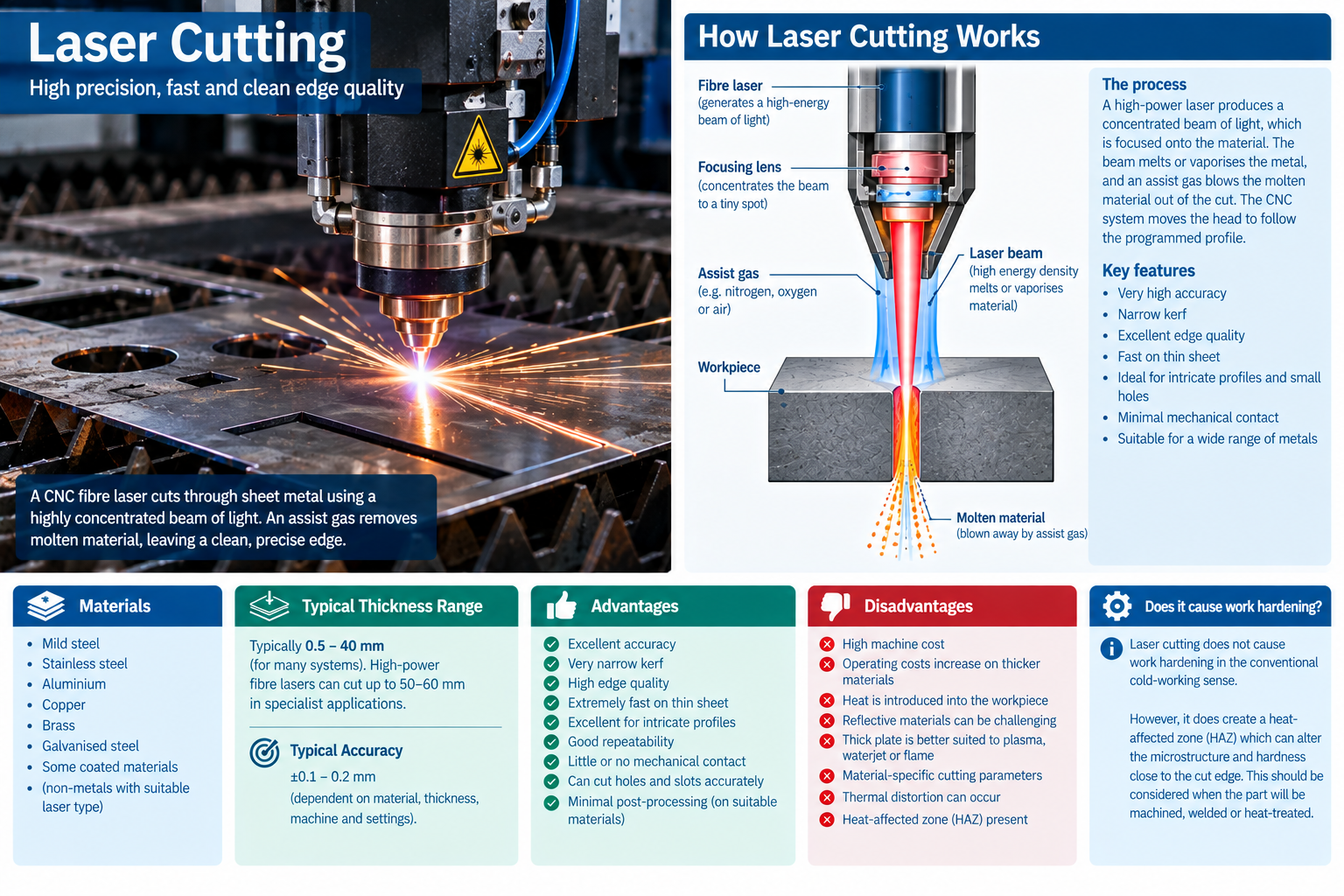
A highly concentrated laser beam melts or vaporises material while an assist gas removes molten material from the cut.
Modern industrial machines predominantly use fibre lasers, although CO₂ lasers remain useful for some applications, particularly wood and acrylic.
How does laser cutting work?
The laser produces a concentrated beam of light which is focused through optics onto the material.
The extremely high energy density heats the material until it melts or vaporises.
An assist gas then clears the molten material from the kerf.
The cutting head is controlled by CNC software which follows the profile generated from the customer’s CAD drawing.
Because the laser beam is extremely small, the resulting kerf can be very narrow.
TRUMPF describes laser cutting as a contact-free process capable of cutting both metallic and non-metallic materials. (TRUMPF)
What materials can a laser cut?
Industrial fibre lasers can cut:
- Mild steel
- Stainless steel
- Aluminium
- Copper
- Brass
- Galvanised steel
- Some coated materials
Laser technology can also be used for non-metallic materials, although the appropriate laser type depends heavily on the material.
Maximum laser cutting thickness
Laser cutting is particularly effective on thinner materials.
As an example, modern industrial machines can cut approximately:
- Mild steel: 25–40 mm, with higher-power systems reaching around 50–60 mm in specialist applications
- Stainless steel: 25–40 mm+
- Aluminium: 25–40 mm
- Copper: generally thinner
- Brass: generally thinner
TRUMPF’s current high-power fibre laser systems list capabilities extending to 60 mm for some mild and stainless steel applications. (TRUMPF)
However, laser cutting becomes increasingly expensive and less attractive as material thickness increases.
Laser cutting accuracy
Laser is one of the most accurate thermal profiling processes.
For straightforward sheet-metal profiles, around ±0.1–0.2 mm can be a reasonable practical expectation, although actual capability depends on machine condition, material, thickness, geometry and tolerance requirements. (CNC Industries)
Laser cutting is particularly good at:
- Small holes
- Narrow slots
- Intricate profiles
- Fine details
- Repeated production parts
Advantages of laser cutting
- Excellent accuracy
- Very narrow kerf
- Excellent edge quality
- Extremely fast on thin sheet
- Excellent for intricate profiles
- Good repeatability
- Little or no mechanical contact with the material
- Can cut holes and slots accurately
- Excellent nesting efficiency
- Minimal post-processing on suitable materials
Disadvantages of laser cutting
- Relatively high machine cost
- Operating costs increase on thicker materials
- Heat is introduced into the workpiece
- Reflective materials can be challenging
- Thick plate is generally better suited to plasma, waterjet or flame
- Cutting parameters are material-specific
- Thermal distortion can occur
- A heat-affected zone is present
Does laser cutting cause work hardening?
Laser cutting does not cause work hardening in the conventional cold-working sense.
However, it does create a heat-affected zone (HAZ).
Depending on the material, the heat input can alter the microstructure or hardness close to the cut edge. This can be particularly important when cutting steels that are susceptible to hardening.
For components that will subsequently be machined, welded or heat-treated, the effect of the HAZ should therefore be considered.
3. Plasma Cutting
Plasma cutting is a very productive process for cutting electrically conductive metals.
It is particularly useful for medium and thick plate where laser cutting becomes less economical.
How does plasma cutting work?
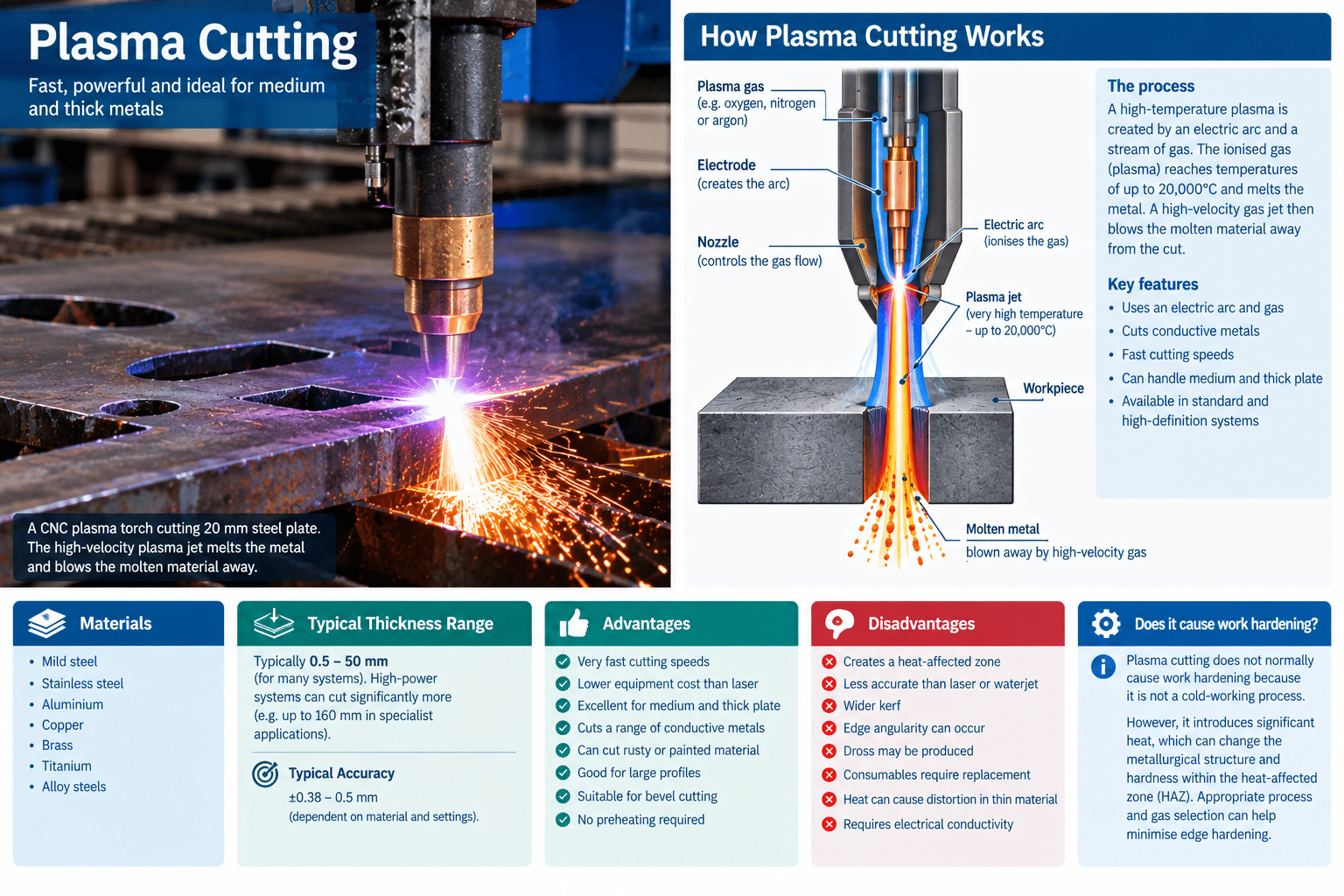
A plasma cutter uses an electric arc and a high-velocity gas stream.
The gas is forced through a small nozzle and becomes ionised by the electrical arc.
This produces an extremely hot plasma jet capable of melting the metal.
The high-velocity gas then blows the molten metal away from the cut.
The CNC machine moves the torch along the programmed profile.
What materials can plasma cut?
Plasma can cut most electrically conductive metals, including:
- Mild steel
- Stainless steel
- Aluminium
- Copper
- Brass
- Titanium
- Some alloy steels
Unlike flame cutting, plasma is not restricted to mild steel.
Hypertherm states that plasma systems can cut carbon steel, stainless steel, aluminium, tool steel and titanium. (Hypertherm)
How thick can plasma cut?
Plasma thickness capability depends heavily on the power of the system.
A useful general range is:
0.5–50 mm for many industrial applications.
High-powered industrial systems can go much further.
For example, Hypertherm’s HPR systems can cut considerably more than 50 mm, with specialised equipment reaching approximately 160 mm when edge-starting certain materials. (Hypertherm)
This illustrates why it is important not to quote a single “maximum plasma thickness” without specifying the machine.
Plasma accuracy
Standard plasma is less accurate than laser or high-quality waterjet.
Modern high-definition plasma systems can, however, achieve excellent results.
Hypertherm reports tolerances around ±0.38–0.5 mm under specified conditions, with edge angularity depending on material thickness. (Hypertherm)
High-definition plasma can therefore be suitable for many fabricated components without requiring extensive machining afterwards.
Advantages of plasma cutting
- Very fast
- Lower equipment cost than high-power laser
- Excellent for medium and thick plate
- Lower operating cost than laser on many thicker materials
- Cuts mild steel, stainless and aluminium
- Can cut rusty or painted material
- Good for large profiles
- Suitable for bevel cutting
- Modern HD plasma gives excellent edge quality
- No preheating required
Disadvantages of plasma cutting
- Creates a heat-affected zone
- Less accurate than laser
- Wider kerf
- Edge angularity can occur
- Dross may be produced
- Consumables require replacement
- Thin sheet can be more difficult to control
- Heat can cause distortion in thin material
- Requires electrical conductivity
Plasma and work hardening
Plasma cutting does not normally cause “work hardening” because it is not a cold-working process.
However, it does introduce substantial heat into a relatively small area.
Certain steels can experience changes in hardness within the HAZ. Hypertherm notes that appropriate process and gas selection can minimise edge hardening. (Hypertherm)
This is an important distinction when a plasma-cut component will subsequently be machined, tapped or welded.
4. Flame Cutting / Oxy-Fuel Cutting
Flame cutting, also known as oxy-fuel or oxy-acetylene cutting, is one of the oldest industrial metal profiling methods.
It remains extremely useful because it can economically cut very thick steel plate.
How does flame cutting work?
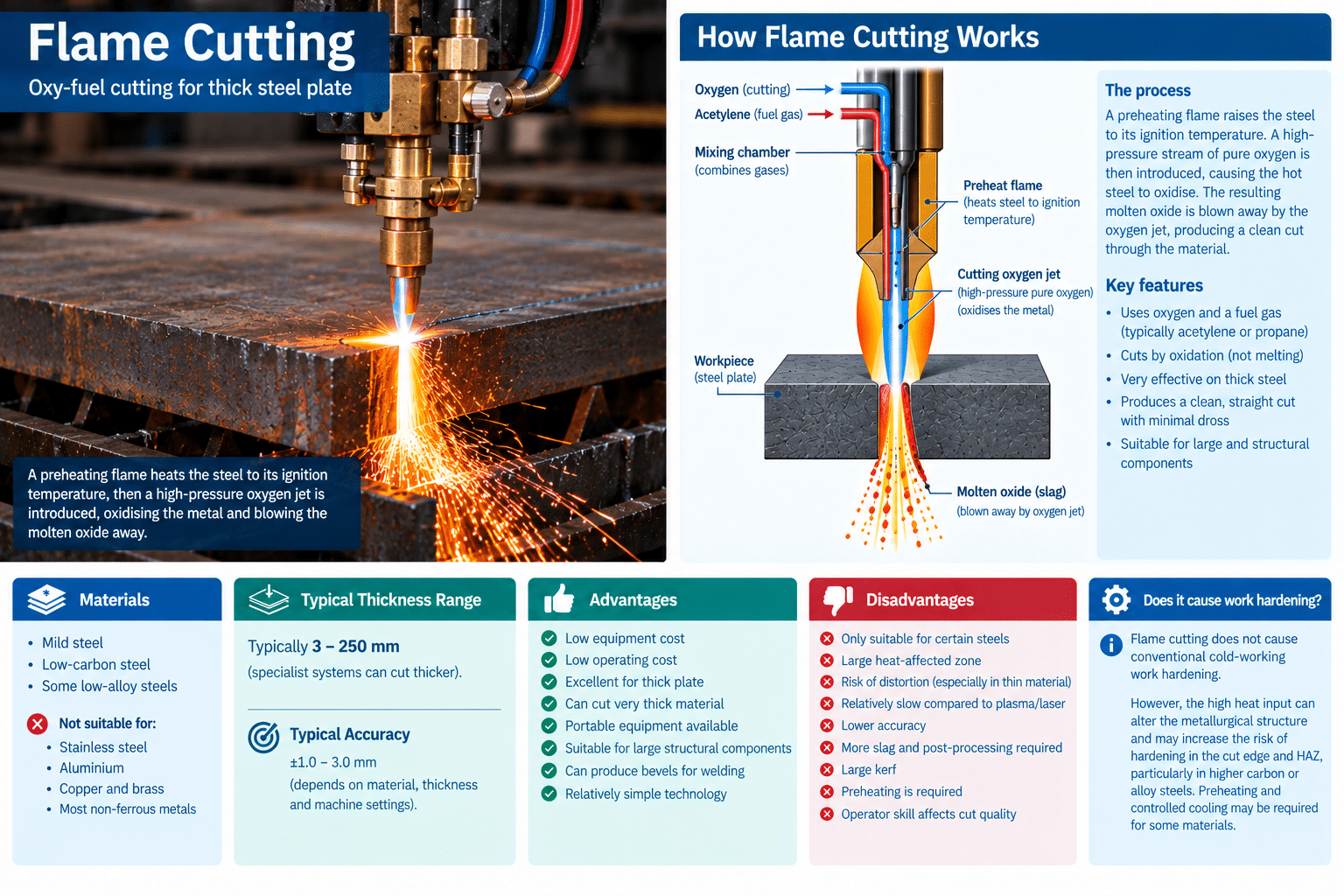
Unlike laser and plasma, oxy-fuel cutting does not primarily melt the steel.
A preheat flame raises the steel to its ignition temperature.
A high-pressure stream of pure oxygen is then introduced.
The hot steel rapidly oxidises and the resulting molten oxide, or slag, is blown away by the oxygen jet.
The reaction is essentially controlled oxidation of the steel.
What materials can flame cut?
This is where flame cutting differs dramatically from plasma and waterjet.
It is primarily suitable for:
- Mild steel
- Low-carbon steel
- Some low-alloy steels
It is not normally suitable for stainless steel or aluminium.
The chemistry of the oxide layer prevents the process from working effectively on these materials.
How thick can flame cutting be?
Oxy-fuel is particularly useful for thick steel plate.
Industrial systems can commonly handle approximately 3–250 mm, with specialist systems capable of significantly more.
ISO 9013 covers flame-cut parts from 3 to 300 mm. https://www.iso.org/standard/60321.html
The practical economic advantage of flame cutting becomes particularly obvious as plate thickness increases.
Flame cutting accuracy
Flame cutting is generally less accurate than laser, waterjet or modern high-definition plasma.
The process introduces a large amount of heat, and the flame and oxygen jet are physically larger than a laser beam.
It is therefore better suited to:
- Large structural components
- Heavy plate
- Brackets
- Welded fabrications
- General engineering
- Parts where secondary machining is expected
It is less suitable for tiny holes or intricate profiles.
Advantages of flame cutting
- Very low equipment cost
- Low operating cost
- Excellent for thick mild steel
- Can cut extremely thick plate
- Portable equipment is available
- Useful for site work and repairs
- Relatively simple technology
- Good for large structural components
- Can produce bevels for welding
Disadvantages of flame cutting
- Only suitable for certain steels
- Large heat-affected zone
- Greater risk of distortion
- Relatively slow
- Lower accuracy
- More slag and post-processing
- Large kerf
- Preheating is required
- Operator skill can have a major effect on cut quality
Flame cutting and hardening
This is an important consideration when flame cutting alloy or higher-carbon steels.
The significant heat input can alter the metallurgical structure around the cut edge. Increasing carbon content can increase the risk of hardening in the cut edge.
For some steels, preheating and controlled cooling may therefore be required.
Does metal profiling cause distortion?
One of the biggest differences between these processes is the amount of heat introduced into the material.
Waterjet
Excellent resistance to thermal distortion.
Because it is a cold cutting process, there is no conventional HAZ.
Laser
Low to moderate distortion.
The beam is highly concentrated, so the affected area is relatively small. However, thin sheets and parts with lots of closely spaced cuts can still move as heat builds up.
Plasma
Moderate potential for distortion.
More heat is introduced than with laser, particularly when cutting thin sheet.
Flame
Highest risk of thermal distortion.
The large heat input and relatively slow cutting process can produce significant temperature gradients.
This is particularly important with thin or long components.
What about work hardening?
The term work hardening is sometimes used incorrectly when discussing profile cutting.
Work hardening occurs when a material is plastically deformed, generally through cold working.
Thermal cutting does not normally cause work hardening in this conventional sense.
However, thermal cutting can cause metallurgical changes and local changes in hardness.
| Process | Conventional work hardening | Thermal/metallurgical change |
|---|---|---|
| Waterjet | Very little | None from heat |
| Laser | No | Small HAZ; material-dependent |
| Plasma | No | HAZ and possible edge hardening |
| Flame | No | Larger HAZ and greater risk of hardening |
This distinction is particularly important when specifying parts that will later be machined, welded, heat-treated or fatigue-loaded.
Which profiling process is cheapest?
There is no universal cheapest process.
The cost depends on material, thickness, quantity, machine utilisation, setup time, cutting speed and the amount of finishing required.
As a broad guide:
Flame cutting
Usually the lowest-cost option for thick mild steel.
The equipment is relatively inexpensive and the consumables are straightforward.
Plasma cutting
Often the most economical option for medium and thick conductive metals, particularly mild steel.
Plasma has a lower equipment cost than a high-power fibre laser and can be very productive on thicker plate. Hypertherm specifically highlights plasma’s cost advantages over laser as material thickness increases. (Hypertherm)
Laser cutting
Often the most economical choice for thin sheet and high-volume production.
Although the machine is expensive, its high speed, narrow kerf and excellent nesting capability can produce a low cost per component.
Waterjet
Usually has a higher cost per cutting hour, particularly when abrasive consumption and slower cutting speeds are considered.
However, it can become the most economical option when the alternatives would require:
- Secondary machining
- Heat treatment
- Grinding
- Edge preparation
- Special tooling
- Additional finishing
- Cutting difficult materials
The cheapest cutting process is therefore not necessarily the one with the lowest hourly rate.
Which profiling process should you choose?
A simple way of approaching the decision is:
Choose waterjet when:
- You need to avoid heat
- Material is heat-sensitive
- You are cutting titanium or exotic alloys
- You are cutting composites
- You need to cut glass, stone or plastics
- You are cutting very thick material
- You need excellent edge quality
- Material is reflective
- Metallurgical changes must be avoided
Choose laser when:
- Material is relatively thin
- High production speed is required
- Excellent accuracy is important
- The profile contains small holes or intricate details
- You need excellent repeatability
- Material utilisation is important
Choose plasma when:
- Material is medium or thick
- The material is electrically conductive
- Production speed is important
- Cost is important
- Some HAZ is acceptable
- Very high precision is not required
- You are cutting large steel components
Choose flame cutting when:
- Material is thick mild steel
- Accuracy requirements are moderate
- Cost is important
- The component is large
- Some heat distortion is acceptable
- Secondary machining will be carried out
- Very thick plate needs to be cut
Material profiling is about more than cutting speed
It can be tempting to select a cutting process simply by asking “Which machine cuts fastest?”
That is not always the right question.
A faster cutting process can actually increase the total manufacturing cost if it produces:
- Excessive distortion
- Poor edge quality
- A hardened edge
- Excessive dross
- Incorrect dimensions
- Additional machining requirements
For example, a waterjet may be slower than a plasma cutter, but if the waterjet produces a finished edge without thermal distortion, it may eliminate a subsequent machining operation.
Likewise, a laser may cost more per hour than plasma, but its speed and accuracy can make it considerably cheaper for hundreds or thousands of thin sheet-metal components.
The best CNC metal profiling process is therefore the one that produces the required component at the lowest total manufacturing cost, rather than necessarily the lowest cutting cost.
Summary: waterjet vs laser vs plasma vs flame cutting
| Requirement | Best choice |
|---|---|
| Avoiding heat | Waterjet |
| Cutting very thick steel | Flame / Waterjet |
| Thin sheet production | Laser |
| Medium/thick steel production | Plasma |
| Stainless steel | Laser / Plasma / Waterjet |
| Aluminium | Laser / Plasma / Waterjet |
| Titanium | Waterjet / Laser / Plasma |
| Composites | Waterjet |
| Glass or stone | Waterjet |
| Intricate thin-sheet profiles | Laser |
| Lowest-cost thick mild-steel cutting | Flame |
| Large structural profiles | Plasma / Flame |
| No heat-affected zone | Waterjet |
| Very thick reflective material | Waterjet |
| High-volume thin-sheet production | Laser |