
How to Choose Materials for Machined and 3D Printed Parts: Metals, Plastics and Composites
Choosing the right material is one of the most important decisions when designing a component for CNC machining, manual machining or 3D printing. Material selection affects strength, weight, durability, machinability, surface finish, cost, temperature resistance and the overall performance of the finished part. Material selection for machined parts especially can be critical for avoiding costly mistakes.
For engineers, designers and product developers, the cheapest material is not always the most economical choice. A material that machines quickly and produces an excellent surface finish may reduce manufacturing costs, while a stronger or more temperature-resistant material may prevent premature component failure.
This guide compares commonly used engineering metals and FDM 3D printing plastics, including their properties, advantages, disadvantages and typical applications.
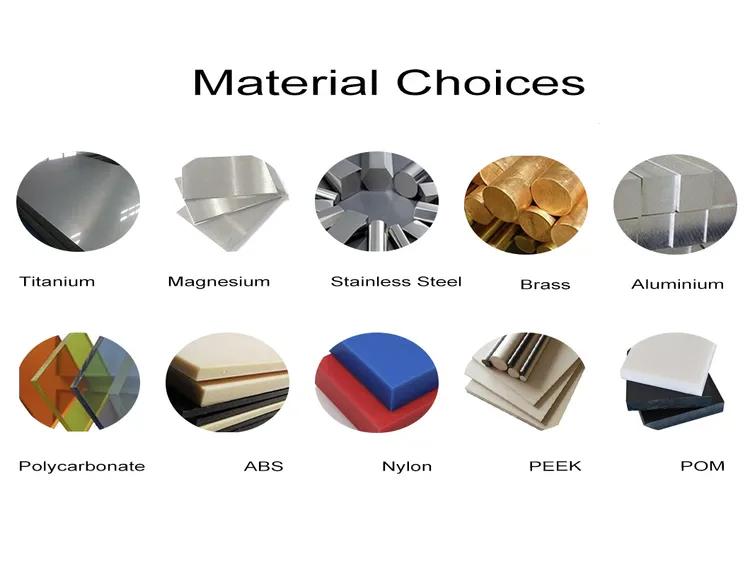
What Should You Consider When Choosing a Material?
Before selecting a material, consider:
- Tensile strength – how much pulling force the material can withstand.
- Yield strength – the stress at which permanent deformation begins.
- Machinability – how easily the material can be cut, drilled, turned or milled.
- Surface finish – the quality of finish achievable after machining or printing.
- Cost – both material cost and manufacturing cost.
- Temperature resistance – important for components exposed to heat.
- Wear resistance – important for moving or contacting components.
- Corrosion and chemical resistance – particularly important in outdoor, marine and industrial applications.
- UV resistance – particularly important for 3D-printed components used outdoors.
- Weight – particularly important for aerospace, automotive and robotics applications.
It is also important to remember that published mechanical properties can vary depending on material condition, section size, manufacturing process and test method. The figures below should therefore be treated as typical or indicative rather than guaranteed design values.
Material Selection for Machined Parts
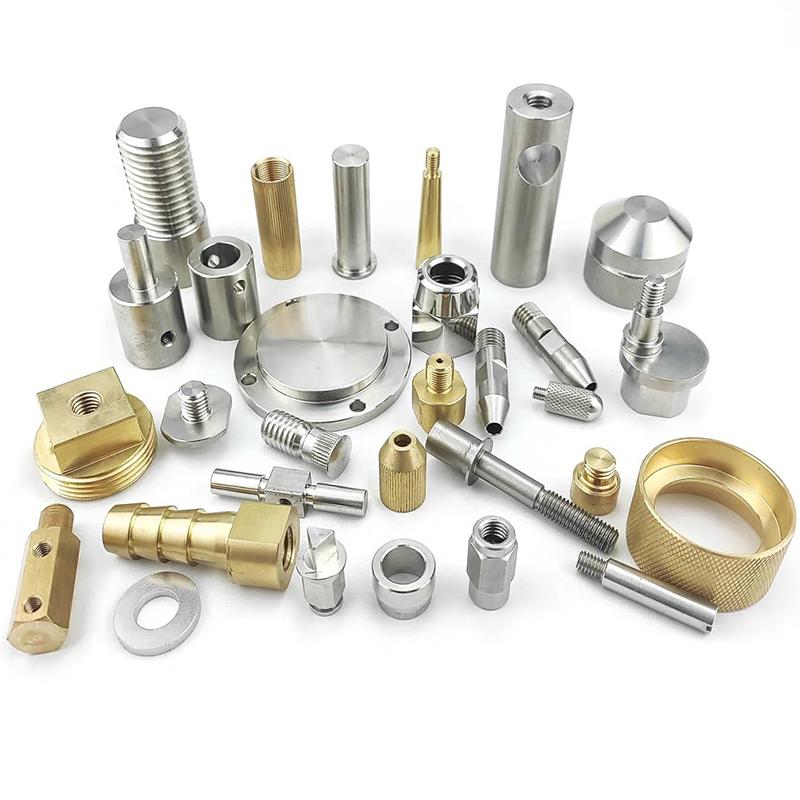
Mild and Engineering Steels
Steel remains one of the most widely used materials for machined components because it provides a good combination of strength, durability, availability and cost.
In the UK, engineers still frequently encounter traditional EN engineering steel designations, including EN1A, EN3B, EN8, EN16 and EN24. These are often accompanied by BS 970 numbers such as 230M07, 080A15, 080M40, 605M36 and 817M40.
When considering material selection for machined parts – It is worth noting that “mild steel” is not one single grade. EN1A, EN3B and EN8, for example, have significantly different compositions and mechanical properties.
Common UK Engineering Steel Grades
| Grade | BS designation | Typical characteristics | Typical tensile strength* | Typical yield/proof strength* | Machinability | Cost |
|---|---|---|---|---|---|---|
| EN1A | 230M07 | Free-cutting steel | ~400–550 MPa | ~250–350 MPa | Excellent | Low |
| EN1A Pb | 230M07Pb | Leaded free-cutting steel | ~400–550 MPa | ~250–350 MPa | Excellent++ | Low |
| EN3B | 080A15 | General-purpose mild steel | ~350–500 MPa | ~200–300 MPa | Good | Low |
| EN8 | 080M40 | Medium-carbon engineering steel | ~580–700 MPa | ~320–550 MPa | Good | Low–medium |
| EN8D | 080A42 | Higher-quality EN8 variant | ~600–750 MPa | ~350–500 MPa | Good | Medium |
| EN8M | 212A42 | Free-machining EN8-type steel | ~550–700 MPa | ~300–450 MPa | Very good | Medium |
| EN16 | 605M36 | Manganese-molybdenum alloy steel | ~650–850 MPa** | ~450–650 MPa** | Good | Medium |
| EN19 | 709M40 | High-strength Cr-Mo steel | ~700–1000 MPa** | ~500–850 MPa** | Moderate | Medium |
| EN24T | 817M40T | High-strength Ni-Cr-Mo steel | ~850–1000 MPa** | ~680–850 MPa** | Moderate | Medium–high |
* Typical values vary significantly with condition, section size and heat treatment.
** Particularly dependent on whether the material is supplied annealed, normalised or heat treated.
The relationship between the traditional EN designations and BS numbers is well established in UK engineering stock references. For example, EN8 is commonly associated with 080M40, EN16 with 605M36, EN19 with 709M40, and EN24 with 817M40.
EN1A and EN1A Pb
EN1A (230M07) is a free-cutting steel designed primarily for machining. It is particularly useful for high-volume CNC turning because its composition promotes efficient chip breaking and good tool life.
EN1A Pb (230M07Pb) contains lead to further improve machinability. This makes it particularly attractive for automatic and CNC production where large numbers of components are required.
Advantages:
- Excellent machinability
- Good surface finish
- Suitable for high-speed machining
- Relatively inexpensive
- Excellent for turned components
Disadvantages:
- Poor choice for welding
- Lower strength than alloy steels
- Not ideal for heavily loaded components
EN1A Pb is particularly useful for bushes, spacers, pins, fittings, small shafts and turned components.
EN3B
EN3B (080A15) is a general-purpose mild steel commonly used for relatively low-stress engineering components.
It offers good machinability and weldability and is suitable for shafts, rollers, brackets, threaded components and general machinery parts.
Its relatively low cost makes it a good choice where high mechanical strength is not the primary requirement.
EN8
EN8 (080M40) is one of the most widely used engineering steels in UK workshops.
It has considerably greater strength than typical mild steel and can be flame hardened or induction hardened when additional surface hardness and wear resistance are required. Typical EN8 material in a normalised condition has a minimum tensile strength around 580 MPa for smaller sections, although values vary with section size and condition.
Typical applications include:
- Shafts
- Pins
- Axles
- Gears
- Bolts
- Machine components
- Fixtures and tooling
EN8D is a higher-quality variant, while EN8M is a free-machining version intended to improve machinability.
EN16
EN16 (605M36) is a manganese-molybdenum alloy steel offering greater strength and toughness than ordinary carbon steels.
It has good ductility, shock resistance and machinability and is commonly used for shafts, connecting rods, axles, pins and heavily loaded engineering components.
It is a useful choice where EN8 does not provide sufficient strength or resistance to shock loading.
EN19
EN19 (709M40) is a chromium-molybdenum alloy steel with high tensile strength and good toughness.
It is commonly used for:
- Shafts
- Gears
- Crankshafts
- Axles
- High-strength fasteners
- Heavily loaded mechanical components
It can also be heat treated to produce significantly higher strength and hardness.
EN24 and EN24T
EN24 (817M40) is a nickel-chromium-molybdenum alloy steel used for demanding engineering applications.
EN24T refers to the material supplied in a quenched and tempered condition, providing high strength combined with useful toughness. It is commonly selected for shafts, gears, axles and heavily loaded drivetrain components.
The T designation is therefore important. It does not simply represent a different grade of steel; it identifies a particular supply/heat-treatment condition.
Stainless Steel
Stainless steel is an excellent choice when corrosion resistance is more important than the low material cost of ordinary carbon steel.
Three particularly common grades are:
303 Stainless Steel – EN 1.4305 / 303S31
303 stainless steel (EN 1.4305, commonly 303S31) is a free-machining austenitic stainless steel developed specifically to improve machinability compared with grades such as 304.
Sulphur is deliberately added to the steel, forming manganese sulphide inclusions that help break chips and reduce cutting forces. This makes 303 particularly attractive for CNC turning and milling, especially where large numbers of components need to be produced efficiently.
Typical mechanical properties for 303 / EN 1.4305:
- Tensile strength: approximately 500–700 MPa
- Yield/proof strength: approximately 190 MPa minimum
- Machinability: Excellent for a stainless steel
- Surface finish: Very good when correctly machined
- Corrosion resistance: Good for general engineering use, but below 304 and 316
- Weldability: Poor
- Heat treatment: Cannot be hardened by conventional heat treatment
- Cost: Generally moderate; often economical for machined components because of its excellent machinability
- Typical applications: Shafts, pins, threaded components, fasteners, valve bodies, pneumatic manifolds, precision components and aircraft fittings.
Advantages of 303:
- Excellent machinability compared with most austenitic stainless steels
- Excellent chip breaking
- Reduced tool wear compared with 304
- Capable of producing good surface finishes
- Good dimensional stability during machining
- Good general corrosion resistance
- Particularly suitable for high-volume CNC production
- Available in round, hexagonal and other bar forms
Disadvantages of 303:
- Lower corrosion resistance than 304 and 316
- Poor weldability
- Not recommended for severe marine or chloride environments
- Sulphur additions reduce some of the corrosion resistance and toughness
- Not suitable where maximum corrosion resistance is the primary requirement
EN 1.4301 / 304
304 stainless steel is a general-purpose austenitic stainless steel with good corrosion resistance, good appearance and good machinability.
Typical applications include:
- Food-processing equipment
- Machine components
- Fixtures
- Architectural components
- General engineering
Typical tensile strength is approximately 540–750 MPa, depending on product form and condition.
EN 1.4404 / 316L
316L provides improved corrosion resistance, particularly in chloride-containing environments.
It is commonly used for:
- Marine equipment
- Chemical equipment
- Food and pharmaceutical machinery
- Outdoor components
- Medical equipment
Typical solution-annealed material has tensile strength around 500–700 MPa, depending on section and specification.
Disadvantages of stainless steel:
- More expensive than mild steel
- Generally more difficult to machine
- Work hardening can be a problem with grades such as 304 and 316
- Can produce poorer surface finish if machining parameters are incorrect
Aluminium
6082-T6 is one of the most useful aluminium alloys for general CNC machining.
It offers an excellent combination of:
- Low weight
- Good strength
- Good machinability
- Corrosion resistance
- Attractive surface finish
- Relatively low material cost
6082-T6 can have tensile strength around 295–310 MPa and proof strength around 250–260 MPa, depending on section size.
Typical applications include:
- Machine frames
- Brackets
- Housings
- Automotive components
- Aerospace components
- Fixtures
- Robotics
Aluminium can also be anodised, producing a hard, corrosion-resistant and attractive surface.
Acetal (POM)
Acetal, commonly supplied as POM-C, is one of the most useful engineering plastics for CNC machining.
It has excellent dimensional stability, low friction and good wear resistance.
Typical POM-C properties include approximately:
- Tensile strength: 67 MPa
- Tensile yield strength: 67 MPa
- Flexural strength: approximately 91 MPa
For this article, flexural strength is retained only where it is useful for plastics; it is deliberately not used as a comparison parameter for metals.
Advantages:
- Excellent machinability
- Excellent surface finish
- Low friction
- Good dimensional stability
- Low moisture absorption
- Good wear resistance
Disadvantages:
- Lower strength than metals
- Can creep under sustained loads
- Limited high-temperature performance
Typical applications include bearings, bushes, gears, rollers, guides, spacers and precision machine components.
Brass
Brass is particularly attractive for components requiring excellent machinability and an attractive surface finish.
CW614N / CZ121 is a commonly used free-machining brass. Its lead content improves chip breaking and machinability, making it particularly suitable for CNC turning.
Depending on condition, CW614N can have tensile strength values from approximately 360 to 500 MPa.
Advantages:
- Excellent machinability
- Excellent surface finish
- Good corrosion resistance
- Attractive appearance
- Good dimensional stability
Disadvantages:
- More expensive than mild steel
- Lower strength than many alloy steels
- Relatively high density
Typical applications include valves, fittings, connectors, bushes, shafts, decorative components and plumbing components.
FDM 3D Printing Materials
FDM 3D printing provides access to a wide range of thermoplastics. However, printed parts behave differently from machined components because strength depends heavily on layer orientation, infill, nozzle temperature, printing parameters and part geometry.
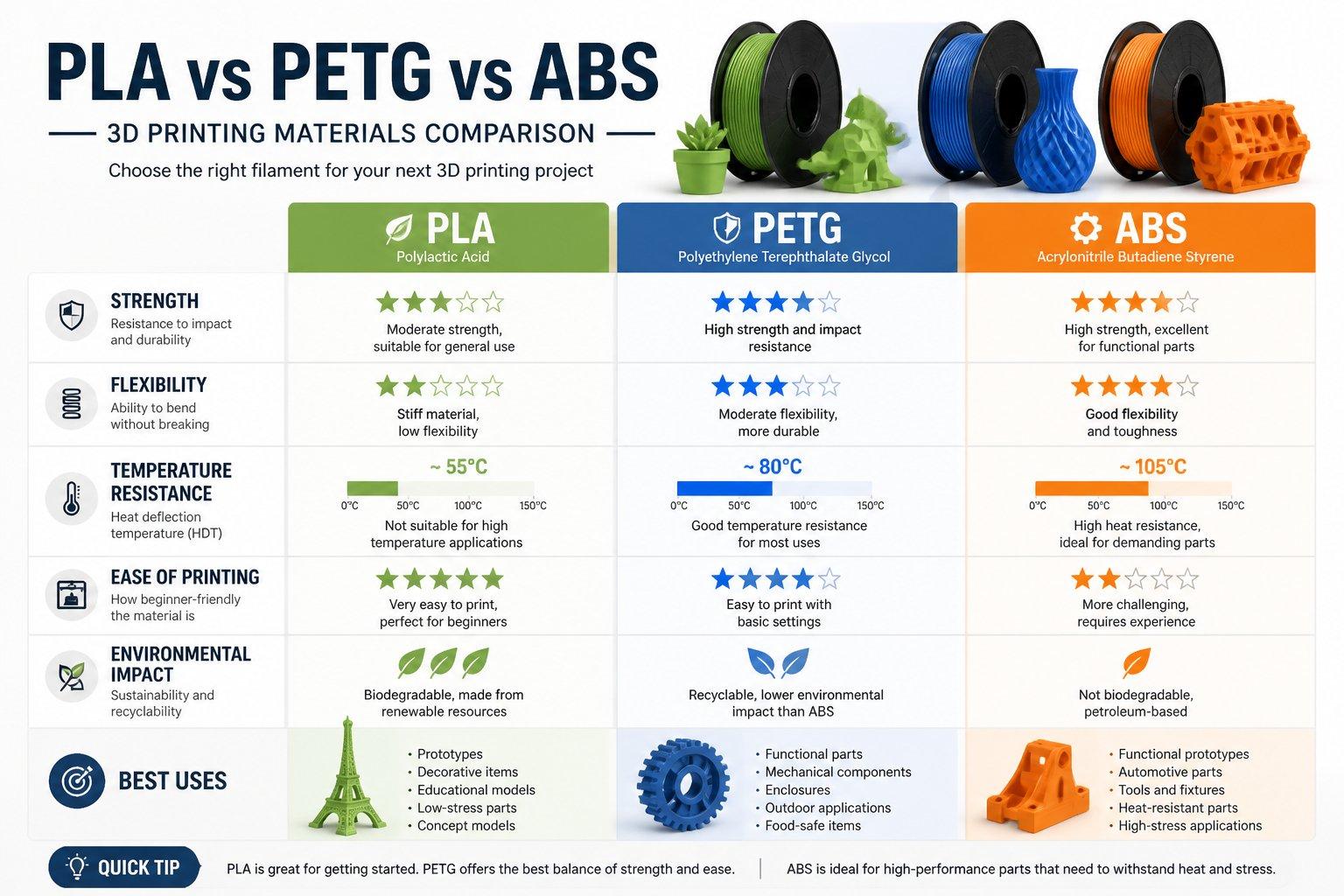
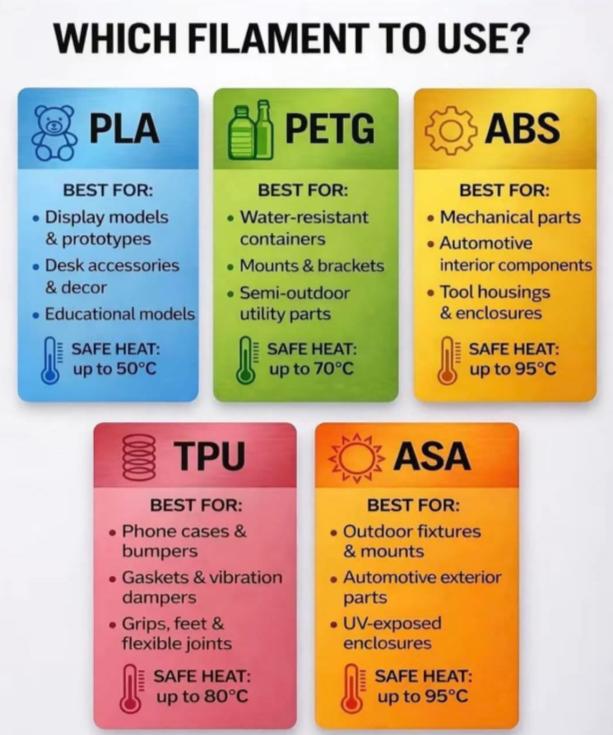
PLA
PLA is inexpensive, easy to print and capable of producing excellent dimensional accuracy and surface quality.
Typical tensile strength is around 50–60 MPa, while heat resistance is generally limited to approximately 55–60°C.
Best for:
- Prototypes
- Visual models
- Fixtures
- Concept development
- Low-temperature applications
Disadvantages: relatively poor heat resistance and limited long-term outdoor performance.
PETG
PETG provides a useful balance between strength, toughness and ease of printing.
Typical tensile strength is approximately 50 MPa, with heat deflection around 70–76°C depending on material and test method.
It has good layer adhesion and is more impact resistant than PLA.
Best for:
- Functional prototypes
- Brackets
- Covers
- Enclosures
- General engineering prototypes
ABS
ABS is a traditional engineering thermoplastic with better heat resistance and toughness than PLA.
Typical tensile strength is approximately 40–50 MPa, with heat resistance commonly around 85–100°C, depending on the material specification.
However, ABS can suffer from warping during printing and is susceptible to UV degradation.
Best for:
- Automotive prototypes
- Machine covers
- Functional housings
- Components requiring moderate heat resistance
ASA
ASA is an excellent choice for outdoor 3D printing.
It offers similar characteristics to ABS but has substantially better resistance to UV radiation and weathering. Some commercial ASA materials are specifically designed for long-term outdoor applications, with tensile strength around 49 MPa and thermal resistance around 96°C.
Best for:
- Outdoor enclosures
- Vehicle components
- Signs
- Garden equipment
- Exterior fixtures
For outdoor parts, ASA is generally a better choice than standard ABS because prolonged UV exposure can cause ABS to degrade, discolour and become more brittle.
Nylon
Nylon provides excellent toughness, wear resistance and impact resistance.
Typical tensile strength can be around 60–70 MPa, depending on grade and printing conditions. Some engineering nylon materials have heat deflection temperatures approaching 90°C.
Nylon is particularly useful for:
- Gears
- Bushes
- Functional prototypes
- Clips
- Brackets
- Mechanical components
Its main disadvantages are moisture absorption and the need for careful material storage and printing conditions.
Polycarbonate
Polycarbonate is one of the stronger and more temperature-resistant materials commonly available for FDM printing.
Typical tensile strength can be approximately 70–90 MPa, with some commercial systems providing thermal resistance around 110–120°C.
Advantages:
- High strength
- Excellent impact resistance
- High temperature resistance
- Good dimensional stability
Disadvantages:
- More difficult to print
- Requires higher nozzle and bed temperatures
- More prone to warping
- Generally more expensive than PLA or PETG
Quick Material Selection Guide
| Application | Recommended material |
|---|---|
| Low-cost general machining | EN3B |
| High-volume CNC turning | EN1A / EN1A Pb |
| General-purpose strong steel components | EN8 |
| Higher-strength shafts and components | EN16 / EN19 |
| High-strength engineering components | EN24T |
| Corrosion-resistant general components | 304 / 1.4301 |
| Marine/corrosive environments | 316L / 1.4404 |
| Lightweight machined components | Aluminium 6082-T6 |
| Low-friction machined components | Acetal POM |
| Excellent-looking machined components | Brass |
| Cheap visual prototype | PLA |
| Tough general-purpose prototype | PETG |
| Heat-resistant printed component | ABS / PC |
| Outdoor 3D printing | ASA |
| Wear-resistant printed component | Nylon |
| High-strength/high-temperature FDM | Polycarbonate |
Final Thoughts
There is no single best material for CNC machining or 3D printing. The correct choice depends on the component’s operating environment, required strength, temperature, corrosion resistance, wear, dimensional accuracy, surface finish and production quantity.
For CNC machining, traditional UK grades such as EN1A, EN3B, EN8, EN16, EN19 and EN24T remain useful reference points when discussing engineering steel with material suppliers and machine shops. The condition designation is particularly important: for example, EN24T has very different mechanical properties from untreated or annealed EN24.
For 3D printing, the manufacturing process itself must also be considered. A material’s datasheet strength does not necessarily represent the strength of the finished printed component because layer orientation and print parameters can have a major effect on performance.
At Profin H.D., material selection can be considered alongside the manufacturing process, tolerances, component geometry and intended application. CNC turning, CNC milling, manual machining and FDM 3D printing can each be appropriate depending on the requirements of the part.